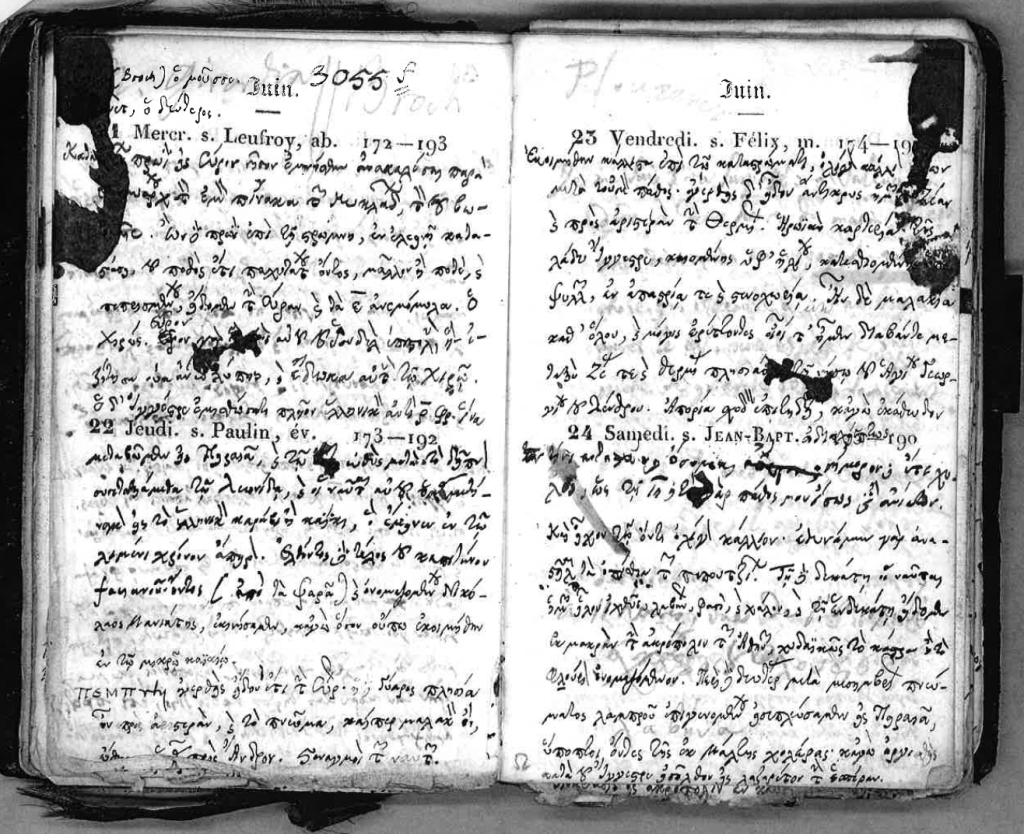
The LAGOOS project is offering a 4-year PhD position as part of its work on the secret diary of K. B. Hase
The LAGOOS project (“A Life in Ancient Greek: The ‘Secret’ Diary of Karl Benedikt Hase”) is looking to recruit a team member at the level of a doctoral student (‘pre-doc’) on a 4-year fixed-term contract to begin in March 2023 or as soon as possible thereafter.
The LAGOOS project is funded by the Austrian Science Fund (FWF) and hosted at the University of Innsbruck’s Institute for Classical Philology and Neo-Latin Studies under PI William M. Barton (FWF identifier Y 1519-G). The project has as its principle aims: 1) a digital edition of the surviving nine volumes of Hase’s Greek diary, alongside the condensed manuscript of excerpts and; 2) a series of analytic studies answering questions about the scholar’s use of Greek, his place in the history of Classical and Byzantine scholarship and his role in Europe’s philhellenic movement.
(The following description of the post’s roles and responsibilities is arranged according to these two principle aims and numbered as such.)
ROLE AND RESPONSIBILITES
For their work towards 1), the digital edition of the text, the doctoral student will be responsible for the transcription of the text of the nine complete volumes of Hase’s diaries, as well as the manuscript of excerpts made by Dübner. This work will be supported extensively by the Handwritten Text Recognition (HTR) tool TRANSKRIBUS, where a model designed for Hase’s Greek hand has already been developed. This transcription of the diary will constitute the first part of the editorial work towards the digital edition of the text. Two further team members, due to join the project in 2024 and 2025, will be responsible for making English translations and summaries of the original Greek text, as well as for compiling commentary notes on the diaries. The ability to collaborate effectively as part of the team working on the digital edition is thus a key competence for this post.
As part of 2) the project’s analytical work, the doctoral student will be responsible for a study of Hase’s use of the Greek language in his diaries, the largest single corpus of ‘Ancient Greek’ text composed in the 19th-century yet identified. Here attention should be paid, on the one hand, to the linguistic features of Hase’s Greek (with numerous Atticizing features alongside examples of high-Byzantine and occasionally Modern Greek vocabulary, for example), as well as to the socio-linguistic context of Hase’s choice of expression. The work towards this study of Hase’s use of the Greek language in his diaries can be foreseen as material for a PhD thesis.
SKILLS AND QUALIFICATIONS
You have an excellent academic record, polished written expression and a demonstrated willingness to perform. You show intellectual curiosity and an enjoyment in primary textual research. Reliable self-motivation, a constructive approach to team work and the enthusiasm to familiarize yourself with new issues in scholarship are among your core strengths.
Required
– An MA degree (or equivalent) in Classical Philology, Ancient or Byzantine Greek Studies (or similar);
– excellent Ancient Greek reading comprehension;
– evidence of training in palaeography and manuscript studies;
– evidence of experience in linguistic research;
– the ability to work productively in a team;
– excellent English, and reading knowledge of German and/or French.
Desired
– Experience in digital humanities;
– Modern Greek skills;
– Latin reading comprehension;
– experience in archival research;
– editorial competences.
KEY WORDS
Ancient Greek Philology / Palaeography / Neo-Ancient Greek / 19th-century literature / Byzantine Philology / Digital Humanities
APPLICATIONS
Applications (consisting of a cover letter, CV, relevant certification, the contact details of a referee and a writing sample) should be sent in PDF format to william.barton@neolatin.lbg.ac.at by 15th November 2022. Shortlisted applicants will be invited to an interview (most probably virtual) in the course of December 2022.
FURTHER DETAILS
Remuneration for the doctoral position follows the salary scheme of the University of Innsbruck. Project collaborators with a completed and relevant Master’s-level degree belong to employment group B1. The monthly remuneration (paid on a 14-month cycle) begins at 3.688€ gross payroll cost (= 2.294€ gross) in 2023.
The LAGOOS project foresees funding for archival visits and international conference attendance for its team members.
General enquires can be sent to the PI at: william.barton@neolatin.lbg.ac.at
 LAGOOS [λαγωoς]