Alongside the project’s analysis of Hase’s work as a scholar and his biography, the LAGOOS team has as a principle aim the digital presentation of the nine surviving years of the original diary text. After preparatory work over the last months, the website for the online presentation of the text is now ready: https://app.transkribus.org/sites/lagoos
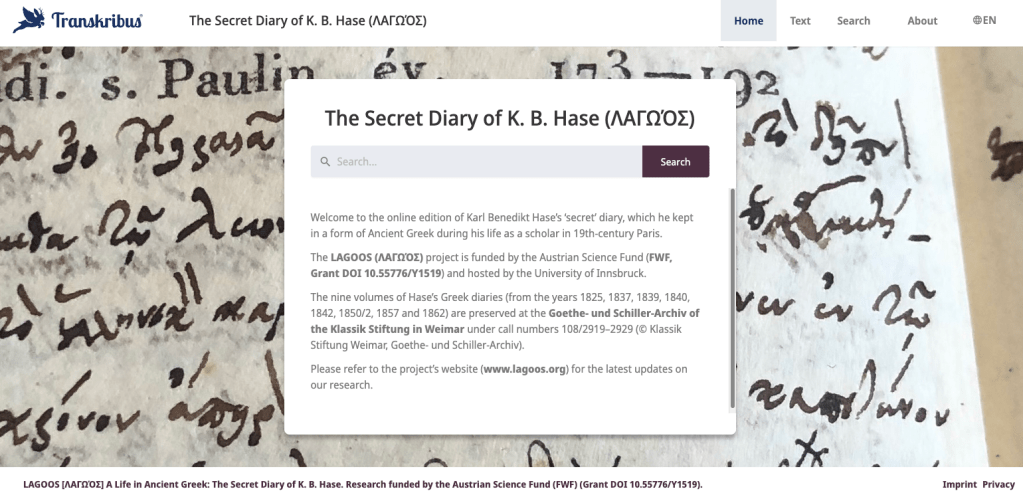
In line with the project’s use of Transkribus’ transcription tools to prepare a machine-readable version of the Greek text, the project also takes advantage of the Transkribus “Sites” platform for its presentation of the text. Sites is open-access and readily available from anywhere online. With this launch of the digital edition, the team presents the text of the earliest preserved diary volume from 1825. Eight further years of the diary will be published on the digital edition website over the coming years of the project.

(https://app.transkribus.org/sites/lagoos/doc/5625950/detail?pageid=23)
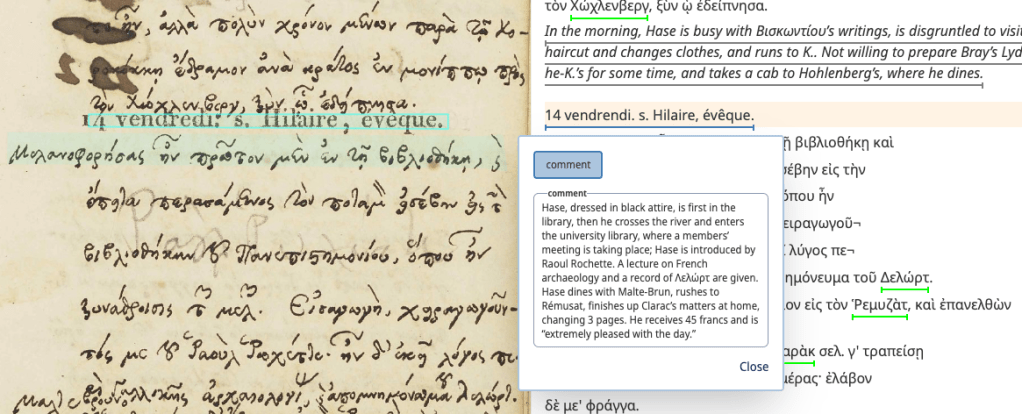
The edition presents the image of the original manuscript, with a facing transcription. Certain elements of the Greek text are marked as “tagged” by being underlined. If the reader clicks on these tagged elements, they can access information about the person, place, publication, event, language etc. recorded by the LAGOOS team in the course of their research. Beneath the Greek text, there then follows the English regestum for each day. These regesta can also be accessed by clicking on the tagged date line (in printed French) of the diary, which opens a comment both with the English text.
Thanks to the “Sites” search function, terms (names, dates, items of vocabulary, places, publications etc.) can be searched in Greek and in English by users interested in particular elements of Hase’s diary.
For more about the online presentation of the text, the editorial choices made by the team, as well as further information on the project itself, please refer to the edition website’s “About” page here: https://app.transkribus.org/sites/lagoos/about.

HAPPY READING!
 LAGOOS [λαγωoς]